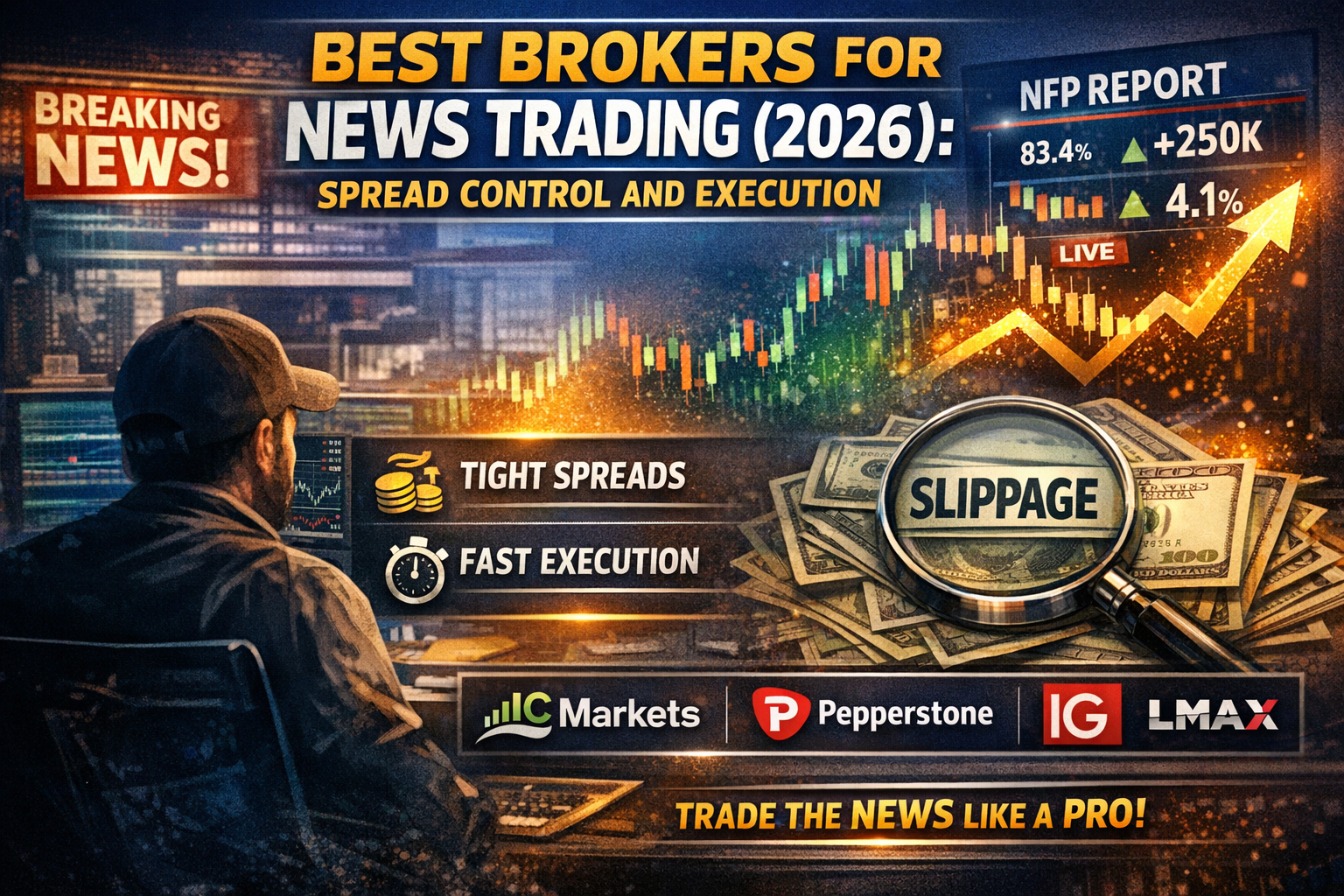
Best Brokers for News Trading (2026): Spread Control and Execution
News trading looks sexy on YouTube. In real life, it’s a knife fight.
Not because you can’t predict direction. Plenty of people guess CPI or NFP right… and still lose, simply because the spread explodes, the fill is late, or your stop gets hit at a worse price than you planned.
That’s why, in 2026, I judge “news-trading brokers” with one brutal question:
When the market goes crazy for 10 seconds, does this broker help me survive… or do they turn my trade into a donation?
Let’s talk about what actually matters: spread control and execution.
The uncomfortable truth about spreads during news
A lot of traders think spread widening is “broker manipulation.”
Most of the time, it’s just liquidity pulling back. Around major releases, even big liquidity providers don’t know what the next tick will be, so they protect themselves by widening spreads.
And when you hit the market with a market order (or a stop that becomes a market order), you open the door to slippage—the difference between the price you expected and the price you got.
So “spread control” doesn’t mean “finding a broker with magical fixed spreads during NFP.”
It means choosing a broker + setup that gives you:
- tight pricing most of the time
- fast, consistent execution
- fair handling of slippage (not one-sided)
- tools to protect you when the spike is violent
What I look for in a news-trading broker
Here’s my personal checklist (simple, but deadly effective):
- Raw spreads + transparent commission (ECN-style pricing)
You want the cost visible, not hidden inside a fat markup. - Clear execution policy and liquidity setup
Brokers that talk openly about multiple liquidity providers and how they route orders are usually the ones built for speed. - Fair slippage behavior
Ideally, the broker acknowledges both positive and negative slippage can happen based on market conditions. - Practical protection tools
For pure “survival mode,” Guaranteed Stop-Loss Orders (GSLO) can be a lifesaver (you pay a premium, but you get the exact stop level even with gaps). - Infrastructure / data center proximity (NY4/LD4, etc.)
Less latency = fewer “why did it fill there?” moments. Some brokers even tell you where their servers sit.
My 2026 shortlist: brokers that actually make sense for news trading
Below is a practical shortlist, grouped by what kind of news trader you are.
1) If you want “raw spreads + fast execution” (the classic news scalper setup)
IC Markets (Raw Spread account)
Why it’s here:
- Raw-spread pricing (they cite very low average spreads on majors and a per-side commission).
- They explicitly talk about aggregated pricing sources and MT4/MT5 server location (NY4), which matters for execution speed.
- Their execution policy acknowledges slippage in volatile/thin liquidity and emphasizes multiple liquidity providers competing on bid/ask.
The catch (be honest with yourself):
- During major news, spreads can still widen and slippage still happens—no broker can delete that reality.
Best for:
- MT4/MT5 traders running EAs, scalpers, and “trade the reaction after the first spike” traders.
Pepperstone (Razor account)
Why it’s here:
- Razor pricing is designed around raw spreads + commission (they publish commission details and position it for active traders).
- Their execution policy openly describes slippage as normal in volatile markets and mentions multiple liquidity providers competing for quotes.
Small detail that matters if you’re on MT4:
- They note MT4 commission handling specifics (how it’s calculated/charged).
Best for:
- News traders who want flexibility across platforms (MT4/MT5/cTrader/TradingView depending on region) and who care about execution transparency.
FP Markets (Raw account)
Why it’s here:
- They market tight spreads + commission on Raw accounts and even mention execution infrastructure (NY4/LD4).
- Their order execution / best interest policy exists in formal PDF form (that’s a good sign: it’s not just marketing).
Best for:
- Traders who want ECN-style pricing on MT4/MT5 and like brokers that talk infrastructure.
2) If you want “more control over slippage” (instead of praying)
Dukascopy (MT4/MT5 + slippage controls)
Why it’s here:
- They document Market Orders with Max.Slippage—that’s literally a tool designed to balance execution probability vs price.
- Their MT4/MT5 info is blunt: market/stop prices aren’t guaranteed; slippage can be substantial in large moves.
Best for:
- Traders who hate random fills and prefer platforms/features that acknowledge and manage the execution reality.
3) If you want “insurance” for the violent spike (GSLO-focused)
Let me say this in plain words:
If your strategy depends on being protected from a gap or a brutal slip… GSLO is one of the only real shields.
You pay for it, but you stop getting surprised.
IG (Guaranteed stops)
- IG explains guaranteed stops clearly: filled at the exact level even if slippage/gapping occurs, with a premium fee.
OANDA (GSLO + slippage symmetry language)
- OANDA offers GSLO (premium charged if triggered).
- Their execution policy language explicitly states they don’t apply asymmetrical slippage parameters (so in theory, positive slippage isn’t “blocked” while negative slippage hits you).
CMC Markets (GSLO + refund logic if not triggered)
- CMC explains GSLO as “guaranteed exit for a fee,” and notes the premium can be refunded if it doesn’t trigger.
Best for:
- Traders who care less about “tightest raw spread” and more about not getting destroyed by one candle.
4) If you’re serious about transparency (exchange-style execution)
LMAX (central limit order book / “no last look” angle)
Why it’s here:
- LMAX positions itself around a central limit order book model and “no last look” liquidity messaging.
- Their materials discuss the difference between firm liquidity vs last look models in the FX industry.
Best for:
- Traders who want exchange-like execution principles (availability depends on access route and account type).
My “news trading execution rules” (the part most people skip)
This is how I reduce broker pain even before choosing a broker:
- Don’t market-order the first second of the release.
That’s where spreads jump and slippage is most brutal. - Trade the second move, not the first spike.
The first spike is chaos. The second move is often the real direction. - Use limit logic when possible (or slippage caps).
Market orders are where slippage hits hardest in volatility. - If one trade can ruin your month, consider GSLO.
It’s not “cool,” but it’s grown-up risk management.
A simple way to “test” a broker for news trading (in one week)
Open demos on 2–3 brokers and do this:
- Pick 3 high-impact events (CPI, NFP, FOMC).
- Record the spread:
- 2 minutes before
- at release
- 1 minute after
- 5 minutes after
- Place the same tiny-size test order (or just watch quotes if you don’t want fills).
- Note:
- how fast orders confirm
- whether slippage feels fair
- whether you get rejected/requotes
After one week, you’ll trust your own data more than any “top 10 brokers” list on the internet.
Final take (from a trader-friend perspective)
If you’re news trading in 2026, your broker isn’t just a place to “open an account.”
Your broker is part of your strategy.
- If you want raw pricing + speed, look at IC Markets, Pepperstone, FP Markets.
- If you want more execution control, Dukascopy is worth a serious look.
- If you want protection from the nasty gap, IG / OANDA / CMC (GSLO) can be the difference between a bad trade and a disaster.
- If you want execution transparency principles, explore LMAX access.