What Makes a Strategy Profitable: Edge vs Randomness
I’m going to talk to you like I’d talk to my younger self—because I’ve been on that road where every win feels like “I figured it out,” and every loss feels like “the market is rigged.”
Here’s the hard truth that saved me years of pain:
A strategy can look profitable without having an edge.
And a strategy can have a real edge but still lose for a while.
The whole game is learning to tell the difference between edge and randomness.
The Most Common Trading Lie: “I’m Profitable Because I Won”
If you flip a coin 10 times, you can get 7 heads.
Does that mean you have a “coin-flip strategy”?
No. It means you got a streak.
Trading is the same. The market can hand you a winning streak even if your strategy is garbage. And it can punish a good strategy for weeks just because probability is not a straight line.
So when people ask me, “What makes a strategy profitable?” I don’t start with indicators.
I start with one question:
Are you winning because of a real edge… or because of randomness?
What “Edge” Actually Means (Simple Definition)
Edge means that over a large number of trades, your method produces a positive result more often than chance would allow, after costs.
That’s it.
Not “it won 8 trades in a row.”
Not “it looks good on a screenshot.”
Not “it felt right.”
Edge is boring. It’s math. It’s repetition.
And the market respects only one thing: repeatable advantage.
Randomness: The Sneaky Thing That Makes Bad Strategies Look Good
Randomness is dangerous because it’s convincing.
It can make you believe:
- your entry is “accurate”
- your indicator is “magic”
- your timing is “special”
- your mindset finally “leveled up”
But it’s just variance doing what variance does.
This is why you’ll see traders get confident right before they blow up:
they confuse a lucky run with proof.
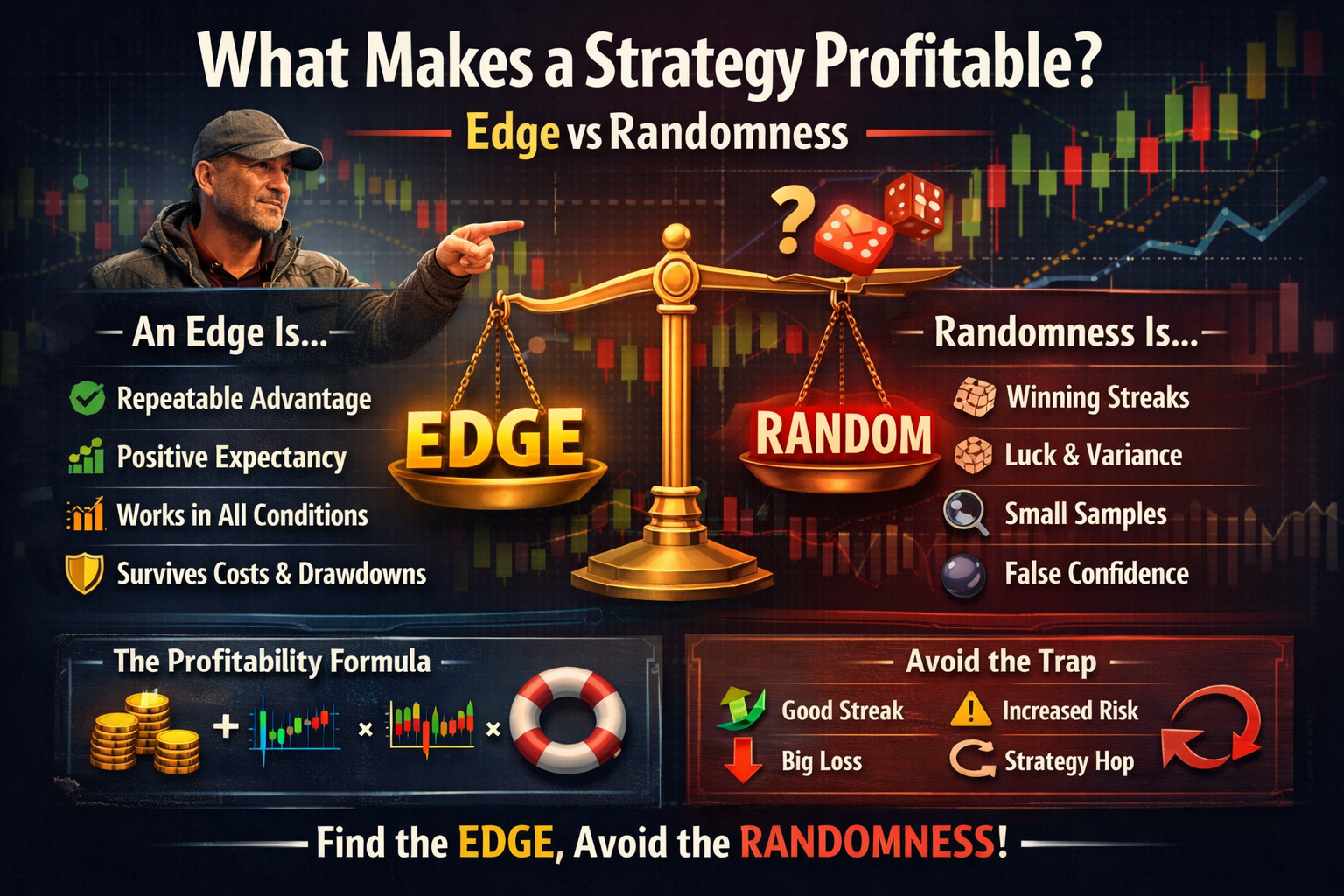
The Profitability Formula (The Real One)
When I assess a strategy now, I reduce it to this:
Profitability = Expectancy × Volume × Survival
Let me translate that like a human:
1) Expectancy
This is the average amount you gain or lose per trade.
If expectancy is positive, you have something real.
If it’s negative, you’re feeding the market.
2) Volume
A good strategy needs enough trades to let the edge show up.
If you take 5 trades a month, you can’t tell edge from luck.
You’re basically gambling on small samples.
3) Survival
Even a strategy with edge can die if your risk is stupid.
If your drawdown can wipe you out before the edge plays out…
then your edge doesn’t matter.
The Real Signs a Strategy Has Edge (Not Hope)
Here’s what I personally look for—because I learned this the painful way.
1) It Works Across Different Market Conditions
If it only works in one “perfect” environment, it’s not edge—it’s a mood swing.
Real edge survives:
- trending days
- choppy days
- high volatility
- low volatility
It doesn’t have to win in all conditions, but it shouldn’t collapse outside one.
2) It Works Across Different Time Periods
If your strategy is “amazing in 2023” but terrible everywhere else, that’s not edge.
A strategy with edge shows up again and again through time—because it’s built on something real, not a lucky season.
3) The Results Are Stable, Not Just High
A strategy that makes money but has wild swings is usually a time bomb.
I’d rather take:
- steady profits
- controlled drawdowns
- consistent behavior
Than a strategy that prints money and then destroys months in one week.
4) It Still Works After Costs
Spreads, commissions, slippage—these are not details.
They’re the difference between “edge” and “fantasy.”
Many strategies are profitable only in theory.
The market doesn’t pay theory.
Where Most Traders Get Tricked: Small Samples
Let me say this clearly, friend:
10 trades means nothing.
50 trades is still weak.
100 trades starts talking.
300+ trades starts becoming evidence.
If you judge your strategy off a small sample, you’re basically reading tea leaves.
And worse—your emotions will start building a religion around a random outcome.
The “Edge vs Randomness” Trap You Must Avoid
This is the classic trap:
- You test a strategy briefly
- You catch a good streak
- You increase risk
- Randomness flips
- You lose confidence or blow up
- You search for another strategy
- Repeat forever
That loop kills more traders than bad entries.
Because it’s not just losing money… it’s losing years.
How I Personally Separate Edge From Randomness
Here’s my simple process:
Step 1: Prove it over a lot of trades
Not one week. Not one “good month.”
A real sample.
Step 2: Break it down by time
Does it work in multiple months? Multiple years?
Step 3: Track drawdown behavior
A strategy isn’t judged by its best run.
It’s judged by its worst stretch.
Step 4: Reduce risk until survival is guaranteed
If you can’t survive the rough periods, you don’t have a strategy.
You have a countdown.
The Truth Most People Don’t Want to Hear
A profitable strategy is not the one with the most wins.
It’s the one that:
- has a real statistical advantage
- survives bad periods
- stays profitable after costs
- can be repeated for a long time
That’s edge.
Randomness is loud, exciting, addictive.
Edge is calm, almost boring, and reliable.
And the market pays boring.
My Final Advice to You (From Someone Who’s Been There)
If you want to become a serious trader, stop asking:
“Is this strategy profitable?”
Start asking:
“Is this strategy profitable because it has edge… or because I got lucky?”
That one question will save you money, time, and mental health.
And if you’re honest with yourself when you answer it?
You’ll become dangerous—in the good way.
Because then you’re not chasing wins.
You’re building a system that deserves them.