Win Rate vs Risk-Reward: The Real Math of Trading (No More Illusions)
If you’ve been trading for a while, you’ve probably felt this temptation:
- “I just need a higher win rate.”
- “No… I need a better risk-reward ratio.”
- “Wait… why am I still not consistently profitable?”
I’ve been there. I used to chase win rate like it was a trophy. Then I chased big risk-reward like it was a secret code. Both can make money… and both can destroy you… if you don’t understand the math behind them.
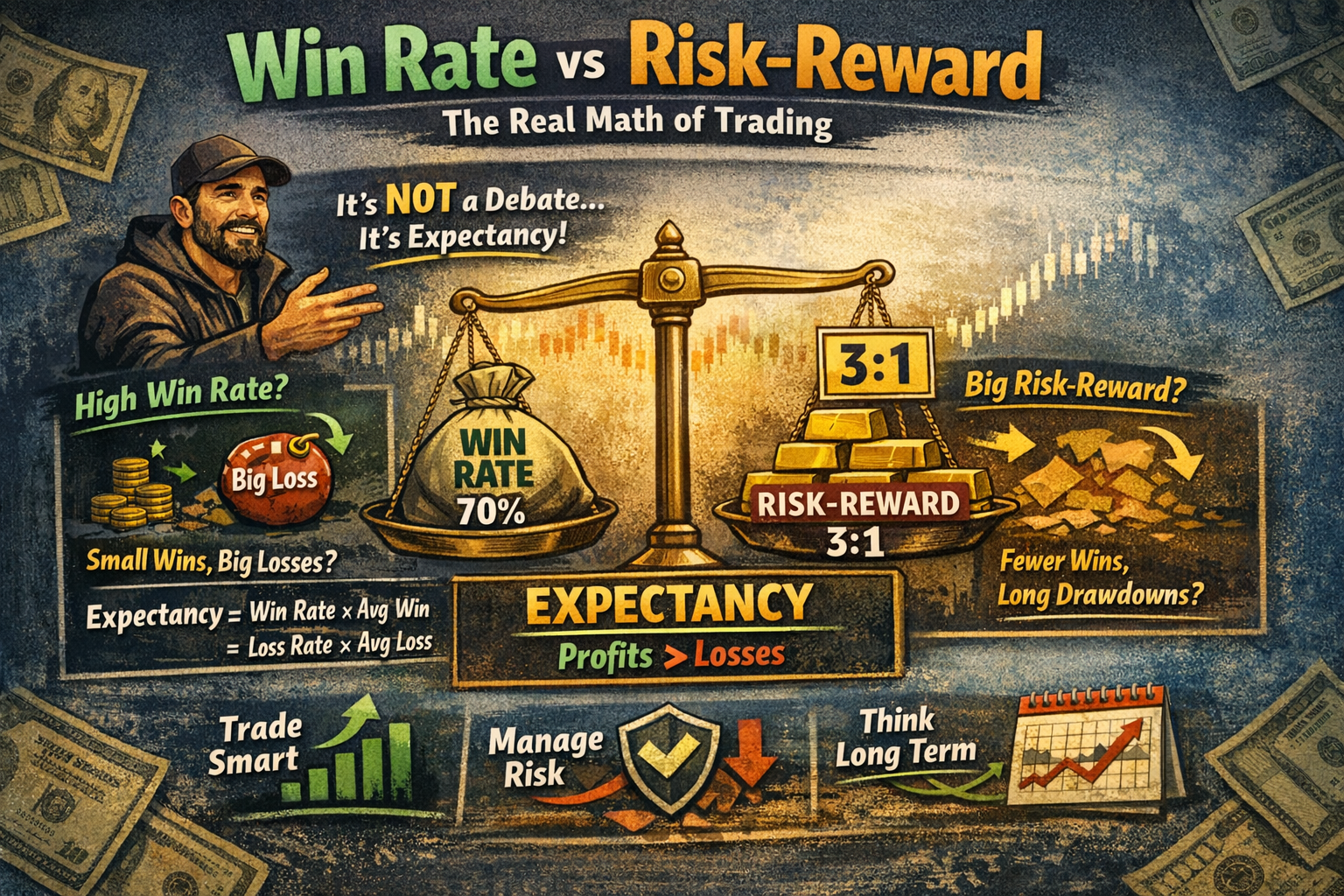
So let’s talk like friends who’ve seen the same mistakes: win rate vs risk-reward is not a debate. It’s a balance. And the real answer is: expectancy.
The Only Trading Math That Matters: Expectancy
Here’s the truth:
A strategy is profitable when, over many trades, it makes more than it loses.
The clean formula is:
Expectancy = (Win Rate × Average Win) − (Loss Rate × Average Loss)
Loss Rate is just: 1 − Win Rate
If you measure everything in “R” (risk units), it gets even simpler.
- Risk 1R per trade (example: you risk $100)
- If you win 2R, you make $200
- If you lose 1R, you lose $100
So expectancy in R becomes:
Expectancy (R) = WinRate × RR − (1 − WinRate)
Where RR is your average reward compared to your risk.
This is the “real math of trading.” Not vibes. Not hope. Not one lucky week.
Win Rate Explained (And Why It Can Mislead You)
Win rate is just:
“How often you win.”
Sounds simple. And that’s why it tricks people.
A high win rate can feel like safety. You feel smart. You feel in control. You start thinking: “This is easy.”
But here’s the danger I learned the hard way:
High win rate often comes with small wins… and big losses
That’s the classic trap:
- Take profits fast (tiny TP)
- Let losses run (wide SL or no SL)
- Win… win… win… win… then one loss wipes the week
So win rate alone is not “good.”
It depends on what you win when you’re right… and what you lose when you’re wrong.
Risk-Reward Ratio Explained (And Why It Can Also Hurt You)
Risk-reward ratio is:
“How much you gain compared to what you risk.”
Example:
- Risk 1 to make 2 → RR = 2:1
- Risk 1 to make 0.5 → RR = 0.5:1
People love big RR because it sounds powerful:
“Bro I only need a few wins.”
True… but big RR usually means:
- You win less often
- You sit through more pullbacks
- You have longer losing streaks
And if your mindset is not ready for that, you’ll sabotage yourself:
- Move your TP closer
- Exit early
- Skip the next trade (and miss the one winner that mattered)
So again: RR alone is not “good.”
It depends on your win rate and your discipline.
The Break-Even Truth: What Win Rate You Need for Any RR
Here’s a simple rule I wish someone tattooed on my brain early:
Break-even Win Rate = 1 / (1 + RR)
Meaning: this is the win rate you need just to NOT lose money (before fees).
Quick examples:
| Risk-Reward (RR) | Break-even Win Rate |
|---|---|
| 1:1 | 50% |
| 2:1 | 33.3% |
| 3:1 | 25% |
| 0.5:1 | 66.7% |
Now you can see the trade-off clearly:
- If your RR is small (like scalping tiny targets), you need a high win rate.
- If your RR is big (letting winners run), you can survive with a lower win rate.
This is where most traders stop… but the real world adds more layers.
Real-World Expectancy Examples (Simple and Brutal)
Let’s use R to keep it clean.
Example A: Low Win Rate, High RR (Trend-following style)
- Win rate = 30%
- RR = 4:1
Expectancy = 0.30×4 − 0.70
= 1.2 − 0.7
= +0.5R per trade
That’s strong. But mentally? You will lose a lot.
Example B: High Win Rate, Lower RR (Scalping style)
- Win rate = 60%
- RR = 1:1
Expectancy = 0.60×1 − 0.40
= +0.2R per trade
Still profitable. Smoother. Less pain.
Example C: Very High Win Rate… but terrible RR (the “trap”)
- Win rate = 80%
- RR = 0.25:1
Expectancy = 0.80×0.25 − 0.20
= 0.20 − 0.20
= 0R (break-even… before costs)
Add spread + slippage + commissions and this becomes negative.
This is why so many “80% win rate” strategies still lose money.
The Hidden Killer: Costs and Slippage
Most beginners ignore this. Professionals don’t.
If you trade often, especially on small targets, costs matter a LOT:
- spread
- commission
- slippage
- bad fills during volatility
A strategy that looks break-even on paper becomes losing in real execution.
That’s why “tiny TP + high win rate” is fragile.
It works in calm conditions… then falls apart when the market gets noisy.
The Part Nobody Wants to Talk About: Losing Streaks
This is where the “best strategy” becomes the “best strategy for YOU.”
Because even a profitable system can feel unbearable.
Rough idea:
- Lower win rate → longer losing streaks
- Higher win rate → shorter losing streaks (usually), but sometimes bigger losses
If you can’t emotionally survive the losing streaks of a low-win-rate system, you will:
- change rules mid-way
- revenge trade
- overtrade
- double risk
- quit right before the winners come back
So yes, expectancy is math… but the execution is psychology.
So… Which One Should You Focus On?
Here’s how I’d tell you as a friend:
1) If you’re a nervous trader
Prefer:
- moderate RR (1:1 to 2:1)
- solid win rate (50–60%+)
- fewer “hero” trades
- cleaner rules
Because your job is consistency, not adrenaline.
2) If you’re patient and disciplined
You can handle:
- bigger RR (2:1 to 4:1)
- lower win rate (30–45%)
- more drawdown swings
- longer holding
But only if you truly follow rules.
3) If you scalp with tiny targets
Then your win rate must be very high… and your execution must be elite.
One messy day and the math breaks.
How to Improve Your Expectancy (Without Becoming a Mad Scientist)
Most traders try to “improve everything” and end up with a strategy that never trades.
Instead, pick ONE lever at a time:
Improve RR (without killing win rate)
- cut losers faster (reduce average loss)
- use smarter exits (partial take profit + runner)
- avoid taking profit too early just to “feel good”
Improve Win Rate (without killing RR)
- trade only your best conditions
- avoid chop (this is where win rate dies)
- align with higher-timeframe bias when possible
The real pro move?
Reduce average loss.
Because every system can have winners… but most traders can’t control losses.
A Simple Self-Check (Do This With Your Journal)
If you don’t track these, you’re trading blind:
- Win rate %
- Average win in R
- Average loss in R
- Expectancy in R
- Biggest losing streak
- Profit factor (optional, but useful)
Even 50 trades is better than guessing from emotion.
My Honest “Guru” Confession
I used to want a strategy that makes me feel right.
Now I only want a strategy that makes me money without breaking my mind.
Some traders worship win rate.
Others worship risk-reward.
But the market doesn’t care what you worship.
It only pays you when your expectancy is positive and you can execute it for long enough.
That’s the whole game.
Quick FAQ :
Is a high win rate better than a good risk-reward ratio?
Neither is “better.” The best is positive expectancy with a style you can execute consistently.
What is a good win rate in trading?
It depends on your RR.
- At 1:1, 55–60% is solid.
- At 2:1, even 40% can work.
Can you be profitable with a 30% win rate?
Yes, if your RR is high enough (example 3:1 or 4:1) and your losses are controlled.
What is the best risk-reward ratio for beginners?
Often 1:1 to 2:1 is more realistic because it doesn’t demand extreme patience or extreme accuracy.
Why do “high win rate” strategies blow up?
Because many hide a “big loss” problem: small wins + occasional huge losses. One loss deletes many wins.
Final Takeaway (Read This Twice)
If you remember only one thing from this article, remember this:
Win rate is how often you’re right.
Risk-reward is how much you get paid when you’re right.
Expectancy is whether you survive and grow.
Don’t chase the feeling of winning.
Chase a system that works on paper and works in your hands.